

































Market Turbulence: Sensex and Nifty Plummet Amidst Global Uncertainties
The Indian stock market experienced a significant downturn on Monday, January 12, 2026, with the Sensex and Nifty indices declining by nearly 1% in late morning trade. This decline was largely attributed to persistent foreign fund outflows, concerns over potential U.S. tariffs on Indian exports, and escalating geopolitical tensions. The 30-share BSE Sensex plummeted 715.17 points or 0.85% to 82,861.07, while the 50-share NSE Nifty tanked 209.9 points or 0.81% to 25,473.40.
Key Factors Contributing to the Decline
Several factors contributed to the market’s bearish sentiment. Foreign institutional investors (FIIs) continued to offload equities, with a net outflow of ₹3,769.31 crore on Friday, January 9. In contrast, domestic institutional investors (DIIs) bought stocks worth ₹5,595.84 crore, attempting to stabilize the market. However, their efforts were insufficient to counterbalance the impact of FII selling. The ongoing geopolitical uncertainties, including tensions in Venezuela, the crisis in Iran, and President Trump’s threats regarding Greenland, also weighed heavily on investor sentiment.
Market Analysis and Expert Insights
According to Ponmudi R., CEO of Enrich Money, an online trading and wealth tech firm, “Indian equity markets opened on a bearish note, extending the cautious tone of the past week as global cues remained mixed. Geopolitical uncertainties, tariff-related concerns, and sustained FII selling continued to weigh on sentiment.” V.K. Vijayakumar, Chief Investment Strategist at Geojit Investments, added, “The market has turned distinctly weak, weighed down by a series of India-specific and global geopolitical events.” These expert opinions highlight the complex interplay of factors influencing the market’s performance.
Sectoral Performance and Global Market Trends
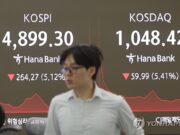
Among the 30 Sensex firms, Eternal, Adani Ports, Mahindra & Mahindra, Bajaj Finance, Bharat Electronics, Larsen & Toubro, Reliance Industries, and Power Grid were among the biggest laggards. In contrast, Trent, NTPC, Asian Paints, and Tata Steel were among the gainers. In Asian markets, South Korea’s Kospi index, Shanghai’s SSE Composite index, and Hong Kong’s Hang Seng index traded higher, while U.S. markets ended in positive territory on Friday, January 9. The global oil benchmark, Brent crude, climbed 0.24% to $63.49 per barrel, further impacting the market’s trajectory.
Future Implications and Potential Outcomes
The current market downturn has significant implications for investors and the overall economy. The sustained FII selling and geopolitical uncertainties may continue to weigh on the market’s sentiment, potentially leading to further declines. However, the Indian economy’s resilience and the government’s efforts to boost growth may help mitigate the impact of these factors. As the market navigates these challenges, it is essential for investors to remain cautious and informed, considering both the potential risks and opportunities that arise from these developments.
Historical Context and Comparative Analysis
The current market situation bears some resemblance to previous periods of uncertainty, such as the 2008 global financial crisis or the 2013 taper tantrum. In both cases, the Indian market demonstrated resilience and adaptability, eventually recovering from the downturns. While historical comparisons are not always exact, they can provide valuable insights into the market’s behavior and potential future outcomes. As the market continues to evolve, it is crucial to consider both the similarities and differences between past and present, allowing for more informed decision-making and strategic planning.