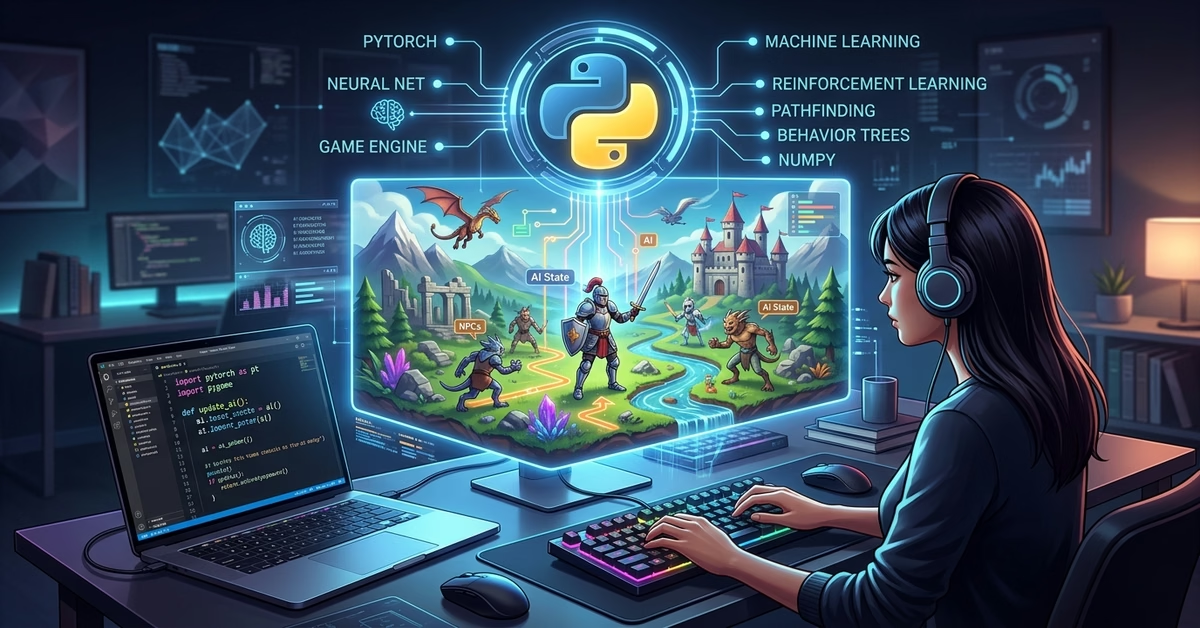
Transforming Python AI Game Development with Reinforcement Learning
In 2013, an algorithm learned to beat human experts at classic Atari titles using only raw screen pixels and a reward signal. A decade later, the underlying math behind that milestone has quietly migrated from academic supercomputers straight into the hands of independent creators. What used to require massive server farms now runs comfortably within standard project folders. For developers working in python ai game development, the shift from scripting predetermined behaviors to training dynamic models changes everything about how digital opponents operate.
This case study examines exactly how a mid-sized indie team, NullState Games, abandoned their traditional logic systems and rebuilt their enemy behaviors entirely. They traded predictable routines for reinforcement learning, creating digital antagonists that actually adapted to player strategies.
They did not have a massive budget. They did not have a dedicated machine learning department. They had standard Python libraries, a willingness to throw out months of hardcoded logic, and a game that desperately needed a more engaging antagonist.
The Wall of Predictability
NullState Games was developing EvoSurvive, a 2D top-down survival action game. The core loop involved players scavenging for resources while being hunted by alien creatures in environments built through procedural generation. Because the maps changed every time a player died, the developers assumed the gameplay would remain fresh indefinitely.
The studio initially approached their enemy design using standard industry tools. They built complex behavioral trees to govern decision-making. They implemented standard pathfinding ai to navigate the randomly generated terrain. They wrote thousands of lines of python scripts to dictate exactly how an enemy should react when the player was reloading, healing, or fleeing.
For the first few hours of playtesting, it worked. The enemies felt smart. They flanked. They retreated when low on health. But by day three of closed beta testing, a glaring issue emerged.
Players are incredibly efficient at recognizing patterns. Within a dozen encounters, testers realized that if they strafed left and fired a secondary weapon, the enemy’s behavioral tree would force it into a defensive blocking animation every single time. The testers stopped playing the survival game and started playing the logic loops. The enemies became predictable, and the game lost its tension.
The developers realized that writing more python scripts was a losing battle. If they added a new branch to the logic tree, players would figure it out in an hour. They needed enemies that learned from the player, not enemies that followed a script.
Shifting the Paradigm to Reinforcement Learning
The team decided to replace their hardcoded enemies with autonomous agents. Instead of telling the enemy what to do in a specific situation, they would give the enemy a goal, a set of actions, and let it figure out the best way to achieve that goal through trial and error.
While setting up the initial architecture, the team relied heavily on established frameworks. Developers looking to understand these foundational setups often consult The Complete Guide to Python AI Development to map out their initial engine dependencies. NullState built their foundation using PyTorch, connecting it directly to their game loop.
They specifically looked at early deepmind algorithms for inspiration. The goal was to implement a Deep Q-Network (DQN). In traditional q-learning, an agent uses a massive table to memorize the value of every possible action in every possible state. In a video game, the number of possible states is nearly infinite, making a simple table impossible. By replacing that table with a neural network, the agent could generalize its experiences. It wouldn’t need to see the exact same situation twice; it could recognize similar patterns and react accordingly.
Implementing neural networks in gaming locally, however, presented immediate technical hurdles. The game engine had to talk to the AI model, the AI model had to make a decision, and that decision had to translate back into movement on the screen—all within sixteen milliseconds to maintain sixty frames per second.
Defining the Senses — What the AI Actually “Sees”
Before the team could train an agent, they had to define its input space. A neural network cannot “look” at a screen the way a human does without requiring massive computational overhead. Passing raw pixel data through convolutional layers was out of the question for a game expected to run on mid-range consumer laptops.
Instead, the team had to distill the game state into a compact array of numbers. They gave the agent a specific set of “senses”:
Raycast distances: The enemy shot invisible lines out in sixteen directions. These lines returned a numerical value representing the distance to the nearest wall or obstacle. This allowed the AI to “feel” the procedural geometry around it.
Relative player coordinates: The agent received the X and Y distance to the player, normalized to a value between -1 and 1.
State flags: The network received binary inputs indicating whether the player was currently attacking, currently reloading, or moving.
Self-awareness metrics: The agent knew its own current health percentage, stamina level, and weapon cooldown status.
In total, the input layer of their neural network consisted of just 28 neurons. This was a deliberate choice. A smaller input space meant a smaller network, which meant faster training and faster decision-making during actual gameplay.
Structuring the Action Space
With the inputs defined, the team had to map the outputs. The output layer of the neural network represented the action space—the things the enemy was allowed to do.
They restricted the outputs to discrete actions:
1. Move North
2. Move South
3. Move East
4. Move West
5. Attack
6. Block
7. Dodge Roll
8. Do Nothing
When the neural network processed the 28 inputs, it output eight numbers, one for each possible action. The highest number dictated what the enemy did on that specific frame.
The Reward Function and the Reality of Game Physics
The most difficult part of reinforcement learning is not building the network; it is defining the reward function. An AI learns entirely based on the points it receives for its actions. If you set up the rewards poorly, the AI will exploit them in ways you never intended.
NullState Games learned this the hard way during their first training epoch.
Initially, they gave the agent a simple reward: +10 points for damaging the player, and -10 points for taking damage. They let the training run overnight in a headless environment. When they woke up and watched the trained agent play, they were horrified. The AI enemy immediately ran to the farthest corner of the map and hid behind an indestructible rock.
Because the game physics allowed the player to shoot projectiles, the AI realized that engaging the player always carried a risk of taking damage (a -10 penalty). Hiding perfectly guaranteed a score of zero. To the AI, zero was better than negative ten. It had achieved exactly what they asked it to achieve, but it ruined the game.
Engineering a Better Motivator
The team had to shape the rewards much more carefully to force the behavior they wanted. They introduced a concept called reward shaping.
The new function looked like this:
* Moving closer to the player: +0.1 points per frame.
* Damaging the player: +50 points.
* Taking damage: -20 points.
* Standing completely still for more than two seconds: -5 points per second.
* Dying: -100 points.
This forced the AI to be aggressive. It could no longer hide because standing still actively drained its score. It had to push forward. Furthermore, they tied the AI directly into the game physics. If the procedurally generated map spawned a mud pit, the AI’s movement speed would drop if it walked through it. Because moving slower meant taking longer to reach the player (missing out on the +0.1 continuous reward), the AI naturally learned to path around mud pits without ever being explicitly programmed to avoid them.
The trained model completely bypassed the need for traditional pathfinding algorithms. It navigated around walls and hazards simply because getting stuck lowered its potential score.
Overcoming the Pygame Integration Bottleneck
Training a reinforcement learning model requires millions of iterations. Playing the game in real-time at normal speed would take months to produce a capable enemy.
NullState’s game was built heavily on Python, requiring careful pygame integration to handle rendering, event loops, and collision detection. Pygame is excellent for 2D logic, but it is bound to the main execution thread. If you try to run a heavy mathematical training loop on the same thread as the rendering engine, the entire program freezes.
The developers solved this by entirely decoupling the game logic from the visual rendering. They built a “headless” version of the game environment. This version stripped out all graphics, all audio, and all frame-rate limiters. It ran nothing but the collision math and the state updates.
By removing Pygame’s visual overhead, they could run the game loop thousands of times faster than real-time. They simulated entire ten-minute matches in less than three seconds. They spun up multiple instances of this headless environment, having the agent play against a hardcoded “bot” player designed to mimic standard human tactics—strafing, retreating, and shooting.
The Problem of Inference Latency
Once the model was trained, they had to put it back into the visual game. This created a new problem.
Running inference—passing the 28 inputs through the neural network to get an action—takes a fraction of a millisecond. That sounds fast. But if you have thirty enemies on the screen, and they all run inference on every single frame at 60 FPS, those fractions of a millisecond stack up. The game’s framerate began to stutter heavily whenever a large wave of enemies spawned.
The developers had to optimize their python ai game development approach. They implemented a staggered thought process. Instead of every enemy thinking every frame, each enemy only updated its neural network every five frames.
If Enemy A made a decision on frame 1, it committed to that action (like moving North) until frame 6. Enemy B made its decision on frame 2 and committed until frame 7. By distributing the inference load across multiple frames, the CPU never spiked. To the player, a reaction time of five frames (about 80 milliseconds) is imperceptible. The enemies still felt incredibly responsive, but the framerate stabilized perfectly.
The Player Experience — Facing the Unknown
After three weeks of training, tweaking the reward function, and optimizing the inference loops, NullState pushed the new AI into a beta build for their testers. They did not tell the testers they had changed the enemy logic.
The results were immediate and drastic.
During the first few matches, the testers tried their old tricks. They tried the strafe-and-fire pattern that used to force the enemies into a defensive block. The autonomous agents fell for it once or twice. But the network had been trained on thousands of variations of player movement. The AI recognized that the player was committing to a predictable strafe.
Instead of blocking, the AI calculated the player’s trajectory, dodged diagonally through the incoming fire, and attacked the space where the player was going to be, rather than where they currently were.
The testers panicked. The forums lit up with players asking if the developers had secretly buffed the enemy speed or damage. The developers had not touched the stats at all. An enemy with 100 health and a sword is a minor nuisance if it runs straight at you. That exact same enemy is terrifying if it knows how to wait for you to empty your magazine before it charges.
Adaptive Difficulty Through Temperature Scaling
One unexpected issue arose: the AI was actually too good. The fully trained model played optimally. It never missed an opportunity to punish a player’s mistake. New players were getting destroyed in the first two minutes of the game.
Because the AI was controlled by a neural network rather than hardcoded logic, the developers could not just tell it to “be dumber.” But they could adjust how confidently it made decisions.
The output of the neural network provides a probability distribution for the actions. Usually, the AI just picks the action with the highest score. The developers introduced a “temperature” variable based on the player’s current health and success rate.
If a player was doing well, the temperature was low, and the AI picked its optimal move 100% of the time. If the player was struggling and near death, the game raised the temperature. This caused the AI to occasionally pick its second or third best option. It might choose to block instead of landing a fatal blow. This created dynamic, organic difficulty. The AI felt like a predator toying with its prey, rather than a robotic terminator executing flawless code.
The Concrete Data and Results
The transition to reinforcement learning fundamentally altered the trajectory of EvoSurvive. NullState Games tracked extensive telemetry data to compare the old behavioral tree system with the new neural network agents.
The metrics revealed exactly how much the player behavior changed:
Session Length Increased: Under the old system, average player session lengths hovered around 14 minutes. Once a player understood the patterns, they got bored and logged off. With the new AI, average session lengths skyrocketed to 42 minutes. The unpredictability kept players engaged longer.
Codebase Reduction: The old hardcoded python scripts required over 8,500 lines of code just to manage enemy decision trees, collision reactions, and edge cases. The new reinforcement learning architecture—including the neural network definition, the PyTorch integration, and the inference loop—required fewer than 1,200 lines of code. The complexity moved from the codebase into the trained weights of the model.
Procedural Adaptability: When the developers added new environmental hazards, like fire traps, to the procedural generation system, they did not have to write new logic for the enemies to avoid them. They simply added a negative reward for standing in fire and let the AI train for an hour. The agents learned to path around the new hazards automatically.
Player Retention: Day-7 retention during beta testing jumped from 22% to 47%. Players reported that the game felt uniquely challenging every time they booted it up.
Key Takeaways
- Behavioral Trees Have Limits: Hardcoded logic is brittle. Players will always find the seams in your scripts and exploit them, reducing your game to a memorization exercise.
- Keep Input Spaces Small: You do not need to feed raw visual data into a network. Using raycasting and relative coordinates provides all the context an AI needs while keeping performance lightning fast.
- Reward Shaping is Everything: AI will always find the laziest way to achieve a high score. You must heavily penalize passivity and actively reward engagement to create compelling enemies.
- Decouple Training from Rendering: You cannot train a model at 60 frames per second. Building a headless environment is a mandatory step for rapid iteration and model training.
- Stagger Inference for Performance: Running a neural network for every enemy on every frame will kill your framerate. Spreading the thought processes across multiple frames keeps the CPU load manageable without sacrificing responsiveness.
So Where Does That Leave You?
The barrier to entry for advanced machine learning in independent games has evaporated. You no longer need a deep background in advanced calculus to implement these systems. The tools available today allow small teams to punch far above their weight class, replacing static code with dynamic intelligence.
NullState’s experience proves that moving away from traditional state machines is not just an academic exercise—it is a practical, achievable method for increasing player engagement. When you stop telling your enemies exactly what to do, and instead give them the tools to figure it out for themselves, the results are startlingly organic.
The future of python ai game development relies on this shift. Players are demanding deeper, more reactive worlds. The developers who continue writing massive, fragile logic trees will find themselves outpaced by those who let their digital creations learn, adapt, and fight back.