Python AI Frameworks Comparison for 2026
Choosing the foundation for your machine learning infrastructure is a commitment that outlasts individual projects, hardware cycles, and engineering trends. When you commit your team or your personal learning path to a specific stack, you are also marrying its ecosystem, its deployment quirks, and its community biases. Evaluating python ai frameworks requires looking past marketing claims to understand how these tools behave when memory limits run tight or when a model refuses to converge at 2:00 AM.
The landscape has solidified over the last few years. While specialized libraries continue to emerge for niche use cases, the heavy lifting of modern machine learning belongs to a very short list of contenders. You have likely arrived at the familiar crossroads: evaluating tensorflow vs pytorch, wondering if newer abstractions are worth your time, or questioning how much deployment pipelines have actually improved.
This comparison strips away the generic advice. We will evaluate the major deep learning tools based on raw developer experience, architectural philosophy, hardware efficiency, and production realities. We will examine exactly where each tool excels, where each one breaks down, and what those limitations mean for your specific workloads.
The State of Python AI Frameworks in 2026
The era of fragmented, highly experimental neural network frameworks is largely behind us. The market has matured into a duopoly, flanked by a few highly specialized alternatives. If you are building artificial intelligence systems today, you are almost certainly choosing between Google’s ecosystem and Meta’s ecosystem, with a few functional programming alternatives waiting in the wings.
Before committing your entire infrastructure to a single ecosystem, exploring the Top 10 Python AI Libraries to Master in 2026 provides necessary context on how these heavyweights interact with data processing, visualization, and specialized mathematical packages. A framework does not exist in a vacuum; it requires a surrounding cast of tools to load data, monitor training progress, and serve predictions.
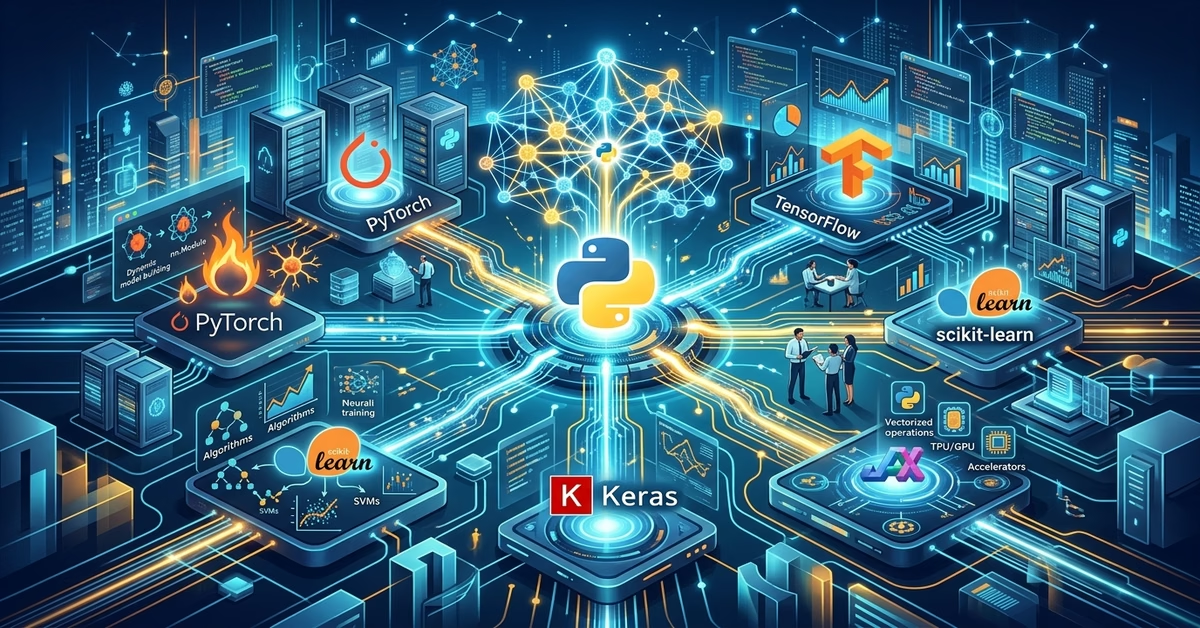
Right now, TensorFlow and PyTorch dominate the conversation regarding python ai tools. They both support automatic differentiation. They both compile down to highly optimized C++ and CUDA routines. They both offer pathways to mobile and edge deployment. The differences between them no longer lie in what they can do, but rather in how they ask you to do it.
TensorFlow vs PyTorch: The Main Event
The most contested debate in ai development remains the head-to-head matchup between TensorFlow and PyTorch. Early on, the dividing line was simple: PyTorch was for academic research, and TensorFlow was for industrial production. That distinction is entirely outdated.
Both frameworks have aggressively copied each other’s strengths. PyTorch improved its deployment story heavily with TorchServe and ExecuTorch, while TensorFlow adopted eager execution to make debugging less of a nightmare. Yet, beneath the surface improvements, their original design philosophies still dictate how it feels to write code in them.
Architecture and Developer Experience
PyTorch was built to feel like standard Python. It executes operations dynamically, meaning the computational graph is built on the fly as your code runs. If you want to know what a specific tensor looks like exactly halfway through a complex neural network layer, you can drop a standard print() statement right into your forward pass. You can use standard Python debuggers like pdb. The learning curve is notably shorter for anyone already comfortable with object-oriented programming in Python.
TensorFlow operates with a slightly different mindset. Even with eager execution enabled by default, TensorFlow is heavily optimized for static graph compilation. To get meaningful performance out of TensorFlow, developers rely on the @tf.function decorator, which traces your Python code and compiles it into a static, highly optimized computational graph.
When this graph compilation works perfectly, the resulting speed is impressive. When it fails, the debugging experience can be highly frustrating. TensorFlow errors often generate massive stack traces referencing internal C++ operations rather than the exact line of Python code where the logical error occurred. PyTorch fails loudly and explicitly at the exact point of execution. TensorFlow sometimes fails during the compilation step, separating the error from your original code context.
Scalability and Distributed Training
Moving from a single graphics card to a cluster of machines introduces entirely new failure modes. True scalability requires a framework that handles communication between GPUs without bottlenecking the actual matrix multiplications.
PyTorch approaches this with DistributedDataParallel (DDP). DDP is heavily favored by engineers training massive language models because it offers explicit, fine-grained control over how gradients sync across machines. It requires writing specific boilerplate code to manage process groups, but that exactness guarantees you know exactly what is happening under the hood.
TensorFlow handles distribution via its tf.distribute.Strategy API. The MirroredStrategy allows you to scale a model across multiple GPUs on a single machine with minimal code changes—often just wrapping your model compilation inside a context manager. For standard enterprise use cases, TensorFlow makes horizontal scaling noticeably faster to set up. However, when things go wrong across a multi-node cluster, untangling TensorFlow’s automated distribution logic can take significantly more time than fixing a manual PyTorch implementation.
Model Deployment and Production Realities
Training a model is only half the battle. Delivering those predictions to a user’s mobile phone, a web browser, or a microservice architecture is where python ai frameworks prove their actual value.
TensorFlow continues to hold a distinct advantage here, heavily favoring engineers who need to deploy beyond standard server environments. The TensorFlow Extended (TFX) pipeline is an industrial-grade machine learning platform. TensorFlow Serving handles gRPC and REST API requests with incredible efficiency. TensorFlow Lite dominates the mobile and edge device market, offering heavy quantization tools that shrink massive models down to run on limited hardware. TensorFlow.js even allows models to run directly in a user’s web browser, offloading computation to the client.
PyTorch has worked aggressively to close this gap. TorchServe is highly capable and heavily used by major tech companies. The introduction of torch.compile in the 2.x releases drastically improved production inference speeds by optimizing the computational graph. For edge devices, ExecuTorch now provides a formal pathway to mobile deployment.
Despite these advances, the PyTorch deployment story still feels slightly more fragmented than TensorFlow’s unified suite. If you are deploying to a fleet of heterogeneous edge devices—drones, smart cameras, mobile phones—TensorFlow provides a more established, battle-tested route. If you are deploying strictly to cloud servers via containers, the deployment gap between the two vanishes entirely.
Hardware Acceleration and Performance Tests
Comparing frameworks on raw speed is heavily dependent on the specific architecture of your neural network. When examining performance benchmarks, both frameworks ultimately call the same highly optimized NVIDIA cuDNN libraries for standard operations.
PyTorch 2.x completely changed the performance conversation with its underlying compiler technology. By analyzing the dynamic graph and fusing operations together before execution, PyTorch can now rival or exceed static graph performance without forcing the developer to write static code.
TensorFlow remains the undisputed king of Google’s Tensor Processing Units (TPUs). While PyTorch supports TPUs via the PyTorch/XLA project, the integration is noticeably more frictionless in TensorFlow. If you are renting massive TPU pods from Google Cloud to train a model, TensorFlow will generally yield better hardware efficiency with less configuration overhead.
However, a third player deserves mention in any performance discussion: JAX. Also developed by Google, JAX is not a traditional neural network framework. It is a highly optimized mathematical library built around the concept of composable function transformations. For researchers pushing the absolute limits of hardware acceleration, JAX frequently tops speed tests by stripping away the heavy abstractions found in both PyTorch and TensorFlow.
The Keras Factor
The conversation surrounding keras has shifted dramatically in recent years. Originally an independent high-level API, Keras was fully absorbed into TensorFlow as tf.keras, acting as its primary interface. For years, writing Keras meant writing TensorFlow.
With the release of Keras 3 (Keras Core), this is no longer true. Keras has returned to its roots as a multi-backend framework. You can now write your neural network layers using the simple, highly intuitive Keras syntax, and choose to run that exact same code on top of TensorFlow, PyTorch, or JAX.
This fundamentally changes how developers approach framework selection. You are no longer locked into a single backend if you start your project with Keras. You can train a model using PyTorch’s backend to take advantage of specific debugging tools, and then switch the backend to TensorFlow for deployment via TensorFlow Lite. Keras serves as a highly effective bridge for teams that want the deployment strengths of one ecosystem and the training strengths of another.
Feature Head-to-Head Comparison
To clarify exactly how these tools stack up across specific dimensions, the following table breaks down the key technical attributes of the leading frameworks.
| Feature / Dimension | PyTorch | TensorFlow | JAX |
|---|---|---|---|
| Execution Model | Dynamic (Eager) by default. Compiled via torch.compile. |
Static via tf.function, Eager available but slower. |
Functional, Just-In-Time (JIT) compiled. |
| Debugging Experience | Excellent. Uses standard Python debuggers (pdb). |
Frustrating. Heavy C++ stack traces on graph errors. | Good, but requires understanding functional purity. |
| Deployment Suite | TorchServe, ExecuTorch (improving rapidly). | TFX, TF Serving, TF Lite, TF.js (industry standard). | Limited native deployment; relies on conversions. |
| Mobile & Edge | Capable, but historically required custom engineering. | Highly optimized, dominant in embedded systems. | Not designed for direct edge deployment. |
| Distributed Training | Manual, explicit control (DDP). Highly favored for LLMs. | Automated, highly abstracted (MirroredStrategy). |
Highly advanced (pjit), requires mathematical rigor. |
| Learning Curve | Gentle for Python developers. Intuitive object-oriented design. | Steep. Heavy abstractions and complex API surfaces. | Extremely steep. Requires pure functional programming. |
Ecosystem and Third-Party Support
The ecosystem around these tools dictates your day-to-day workflow. Anyone managing a modern pipeline should review The Complete Guide to Python AI Development because raw mathematical calculation is only a fraction of the job. You need pre-trained models, specialized loss functions, and data loading utilities.
In the realm of open-source research and pre-trained models, PyTorch has won decisively. Hugging Face, the largest repository of modern machine learning models, is overwhelmingly built on PyTorch. If a new paper is published detailing a massive leap in generative AI, the accompanying code repository will almost certainly be written in PyTorch. While Hugging Face does maintain TensorFlow equivalents for many models, they frequently trail behind in features, and the community support for the PyTorch versions is vastly superior.
TensorFlow’s ecosystem feels heavily corporate and highly structured. TensorFlow Hub provides excellent, production-ready models, but the selection feels constrained compared to the wild, rapid innovation happening in the PyTorch community. However, for highly specific industrial applications—like time-series forecasting for manufacturing or extreme-scale recommendation systems—TensorFlow’s structured ecosystem provides a level of stability that enterprise risk managers heavily prefer.
The Verdict: Which Framework Should You Choose?
Deciding between these options is not about finding the objectively superior software. It is about matching the tool to the specific constraints of your team, your deployment targets, and your timeline.
Here are the specific verdicts based on real-world engineering scenarios:
You should choose PyTorch if:
You are building generative AI, working with large language models, or relying heavily on open-source repositories like Hugging Face. If your team is primarily composed of data scientists who are highly comfortable in standard Python but dislike heavy software engineering abstractions, PyTorch is the clear winner. The debugging experience alone will save your team hundreds of hours. For startups moving fast and researchers testing unproven theories, PyTorch is the only logical choice.
You should choose TensorFlow if:
You are deploying models to highly constrained edge devices, mobile phones, or browsers. If you are walking into a massive enterprise environment with established C++ production pipelines, TensorFlow’s deployment infrastructure (TFX, TF Serving) is worth the steeper learning curve. Choose TensorFlow if your primary concern is cross-platform deployment stability rather than rapid prototyping or accessing the absolute latest research papers on the day they drop.
You should choose Keras (Multi-Backend) if:
You are a beginner learning deep learning for the first time, or if your team prioritizes code readability above all else. By using Keras 3, you get the absolute best high-level API in the industry while retaining the freedom to swap between PyTorch and TensorFlow under the hood as your project evolves.
You should choose JAX if:
You are pushing the absolute mathematical limits of machine learning and require unparalleled speed on massive TPU clusters. JAX is not for standard web developers trying to add a simple classifier to an app; it is for researchers and engineers who view neural networks as pure mathematical functions and demand maximum hardware efficiency without the overhead of standard frameworks.
Frequently Asked Questions
Is TensorFlow losing support or dying?
No. While TensorFlow has undeniably lost the “mindshare” battle in academic research and open-source generative AI to PyTorch, it remains deeply entrenched in massive corporate infrastructures. Google continues to back it heavily, and the global footprint of TensorFlow Lite in mobile applications is staggering. It is not dying; it has simply transitioned from the default research tool into an industrial utility.
Can I train a model in PyTorch and deploy it using TensorFlow tools?
Yes, but the process introduces friction. You can export a trained PyTorch model to the ONNX (Open Neural Network Exchange) format, and then convert that ONNX model into a TensorFlow format. This allows you to use TensorFlow Serving or TF Lite. However, conversion tools often struggle with highly custom neural network layers. It is generally safer to stay within one ecosystem unless you are using Keras as a multi-backend bridge.
Which framework pays better in the job market?
Currently, compensation relies more on your ability to deploy scalable models than the specific syntax you write. That said, heavily funded AI startups focusing on generative AI almost exclusively demand PyTorch. Legacy enterprises and massive tech conglomerates (like Google) still hire heavily for TensorFlow. Mastering PyTorch opens more doors in cutting-edge AI research, while TensorFlow remains a highly reliable ticket into traditional corporate data science teams.
How much math do I need to know to use these frameworks?
The python ai frameworks handle the calculus (automatic differentiation) and linear algebra (matrix multiplications) for you. You do not need to calculate gradients by hand. However, you absolutely must understand the mathematical concepts behind learning rates, matrix dimensions, and probability distributions. Without that knowledge, you will be able to write the code, but you will have no idea how to fix the model when it fails to learn.
Does Apple Silicon (M1/M2/M3) run these frameworks well?
Both TensorFlow and PyTorch now feature native acceleration for Apple’s Metal Performance Shaders (MPS). You can utilize the GPU cores on modern Mac hardware to train models locally at highly respectable speeds. PyTorch’s MPS backend has improved rapidly over the last two years, making local development on MacBooks a genuinely viable option before pushing heavy workloads to cloud GPUs.
Conclusion
The debate surrounding python ai frameworks is often louder than it needs to be. The reality of modern machine learning is that both major ecosystems are highly capable, incredibly fast, and continuously borrowing features from one another.
Your decision ultimately comes down to your destination. If your destination is a mobile application, an embedded system, or a heavily regulated enterprise pipeline, TensorFlow provides the strict, reliable pathways you need. If your destination is the bleeding edge of AI research, rapid prototyping, or integrating the newest open-source language models, PyTorch will get you there with far less frustration. Evaluate your deployment requirements, respect the limitations of your team’s Python experience, and commit to the ecosystem that aligns with your final product.