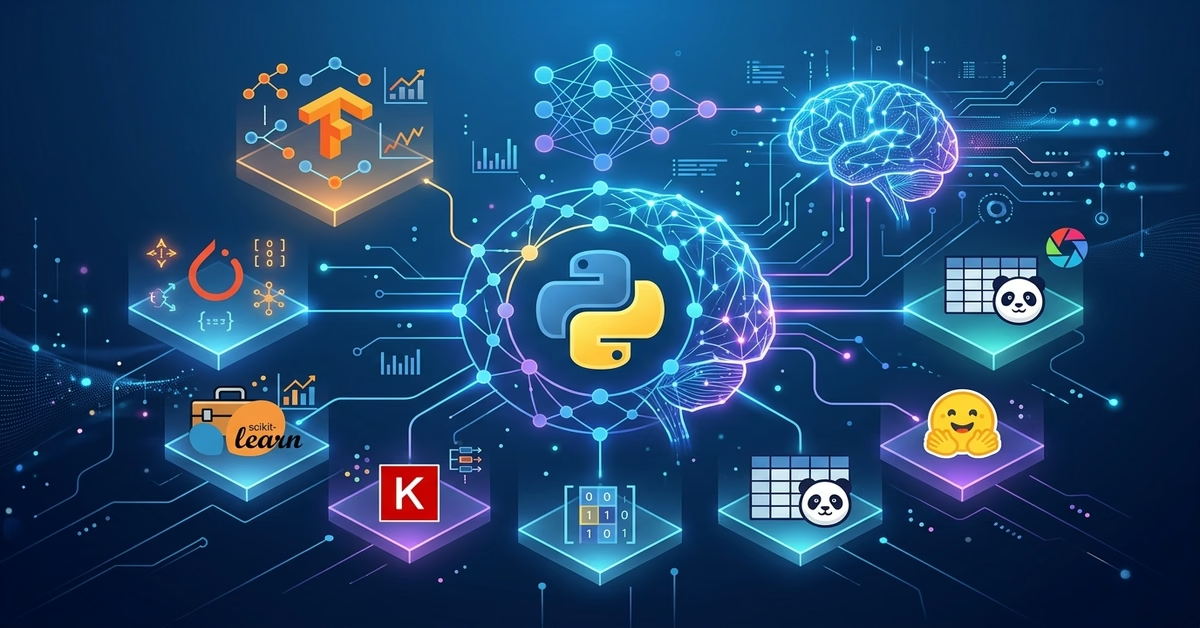
Top 10 Python AI Libraries to Master in 2026
By late 2025, over 8.5 million developers were building artificial intelligence models, yet a staggering 85% of their production code relied on the exact same handful of python ai libraries. The ecosystem surrounding artificial intelligence is massive, but the actual center of gravity is surprisingly small. Most of the magic happens through a tightly knit group of tools that have survived years of aggressive industry filtering.
Learning artificial intelligence does not mean memorizing every new package that trends on GitHub. It means understanding the core foundation that makes modern machine learning, neural networks, and generative models possible. Python remains the dominant language for this work because its community built an ecosystem that hides incredibly complex mathematics behind simple, readable commands.
This list avoids the bloated, outdated tools that only exist in old university syllabuses. These are the top 10 python ai libraries actually driving the industry in 2026. Some handle the unglamorous work of data preparation, others train language models, and a few are rewriting the rules for high-speed calculation. They are ranked logically — starting from the absolute fundamentals and moving up to specialized frameworks.
The Foundation of Data
1. NumPy — The Invisible Mathematical Engine Running the Show
Every single neural network, decision tree, and language model eventually boils down to a massive grid of numbers. If you feed an image into a computer vision model, the model does not see a face — it sees a multidimensional array of pixel values. NumPy is the library that handles those numbers.
Python is notoriously slow at running heavy mathematical calculations on its own. NumPy bypasses this weakness by executing its core operations in C, delivering blindingly fast calculations while letting you write straightforward Python code. It introduces the N-dimensional array, a data structure that allows you to perform complex matrix multiplication across millions of data points instantly.
You will rarely build an entire artificial intelligence system directly inside NumPy, but every other tool on this list relies heavily on it behind the scenes. If you want to understand how data science tools actually process information, you start by learning how NumPy manipulates arrays.
2. Pandas — The Messy Data Cleanup Crew
Real-world data is chaotic. It arrives full of missing values, mismatched date formats, duplicated rows, and general nonsense. Before an algorithm can learn anything, the data has to be pristine. Pandas is the tool that forces messy data into submission.
At its core, Pandas operates around the DataFrame — a two-dimensional, table-like structure that feels similar to an Excel spreadsheet but functions with exponentially more power. With a few keystrokes, you can filter millions of rows, group data by specific categories, fill in missing blanks, and merge multiple massive datasets together. It handles time-series data beautifully and reads from nearly any file format imaginable.
Pandas does have a reputation for consuming a lot of computer memory, which can cause older machines to struggle with exceptionally large files. Despite that, it remains the undisputed king of data manipulation. Once Pandas formats your data correctly, it is finally ready to be fed into actual machine learning libraries.
The Machine Learning Workhorses
3. Scikit-Learn — The Practical Tool for Everyday Algorithms
Not every business problem requires a multi-billion parameter neural network. Sometimes, a simple linear regression, a decision tree, or a random forest algorithm solves the problem faster and cheaper. For these tasks, scikit-learn is the absolute gold standard.
Built on top of NumPy, scikit-learn provides a unified, highly consistent interface for classic machine learning. Whether you are building a model to predict housing prices or an algorithm to group similar customers together, the steps are nearly identical. You initialize the model, fit it to your data, and generate predictions. The documentation is exceptionally well-written, acting almost like a free textbook on machine learning concepts.
For developers mapping out their learning path, The Complete Guide to Python AI Development covers exactly how classic machine learning concepts build the foundation for more advanced neural networks. Scikit-learn is not designed for deep learning, and it will not help you build a conversational chatbot. However, for 80% of everyday corporate prediction tasks, this library is all you need.
4. PyTorch — The Academic Darling That Conquered the Industry
Five years ago, the battle between deep learning frameworks was a dead heat. Today, PyTorch has clearly won the hearts of academic researchers and is aggressively taking over enterprise production environments. Backed by Meta, PyTorch is the engine behind some of the most advanced generative models available.
The main reason developers love pytorch is its “Pythonic” nature. It feels like writing standard Python code. More importantly, it uses dynamic computation graphs. This means the network calculates its mathematical paths on the fly rather than locking them in before the program runs. If your model crashes, you can pause the code, inspect the exact layer where the math failed, and fix it immediately.
PyTorch strikes a rare balance: it is intuitive enough for students learning how backpropagation works, yet powerful enough to train models that require massive clusters of graphics processing units (GPUs).
5. TensorFlow — The Heavyweight Champion for Global Deployment
If PyTorch is the agile sports car built for research and rapid prototyping, TensorFlow is the massive cargo ship designed for heavy-duty, global deployment. Developed by Google, tensorflow was the original heavy hitter that brought neural networks into the mainstream corporate world.
TensorFlow historically had a steeper learning curve than its rivals, often requiring developers to write highly specific, sometimes rigid code. However, it excels where others struggle: putting models into the hands of millions of users. With extensions like TensorFlow Lite and TensorFlow Serving, it makes shrinking a massive model down to run locally on an offline smartphone incredibly straightforward.
Deciding between these two giants depends heavily on your final goal, and analyzing a Python AI Frameworks Comparison for 2026 can help clarify which tool fits a specific production environment. While researchers lean away from it, massive companies with sprawling infrastructure still rely heavily on TensorFlow to keep their systems running.
6. Keras — The Friendliest Entry Point to Neural Networks
Writing raw neural network code from scratch is a guaranteed path to a headache, especially for beginners trying to understand how layers of artificial neurons connect. Keras exists to make deep learning accessible to normal humans.
Rather than functioning as a standalone mathematical engine, keras acts as an interface. Originally, it could sit on top of multiple different backends, but today it is most famously integrated directly into TensorFlow. It allows you to build complex neural networks the same way you would stack Lego bricks. You simply declare a layer, tell it how many neurons you want, and stack the next layer on top.
Keras hides the intimidating calculus and hardware management, letting developers focus entirely on the architecture of their model. Advanced engineers sometimes find it slightly too restrictive when they want to build highly unconventional architectures, but for standard image recognition or text classification, Keras is unmatched in its simplicity.
The Generative AI Era
7. Hugging Face Transformers — The Default Hub for Modern Models
Nobody trains massive language models from scratch on their personal laptops. The computing power required costs millions of dollars. Instead, the modern workflow involves finding a model that a massive tech company already trained and fine-tuning it for your specific needs. Hugging Face Transformers is the library that makes this possible.
This library provides instant access to hundreds of thousands of pre-trained models for natural language processing, audio transcription, and computer vision. With just three lines of code, you can download a model capable of summarizing a ten-page document or translating text between languages. It handles all the complicated text-to-number translation processes — known as tokenization — automatically.
Hugging Face effectively democratized generative artificial intelligence. It took capabilities previously locked inside massive tech corporations and handed them directly to everyday python packages developers.
8. LangChain — The Necessary Plumbing for Language Models
Large language models are brilliant, but they have distinct limitations. They suffer from static memory — meaning they only know facts up until the day their training ended — and they cannot natively access the internet or read a company’s private database. LangChain is the framework designed to fix those exact problems.
LangChain provides the structural plumbing for ai development. It allows you to “chain” different components together. For example, you can write a script that takes a user’s question, searches a private PDF for the answer, hands that specific text to a language model, and then formats the output into a neat paragraph. This process, known as Retrieval-Augmented Generation (RAG), is highly dependent on LangChain’s architecture.
Fair warning: LangChain has a reputation for being somewhat over-engineered. Sometimes developers find themselves fighting the framework’s strict rules when they just want to make a simple API call. Even with those frustrations, it remains the standard toolkit for building complex, multi-step applications powered by language models.
The High-Performance Future
9. JAX — Google’s High-Speed Math Engine
While PyTorch and TensorFlow dominate the current landscape, JAX is the quiet overachiever that advanced researchers are currently flocking to. Also developed by Google, JAX is not exactly a traditional neural network framework. Instead, it is highly optimized software for high-performance numerical computing.
JAX takes the familiar, easy-to-read syntax of NumPy and supercharges it. It uses an advanced compiler under the hood that translates your Python code into instructions that run flawlessly on heavily clustered GPUs and TPUs. Furthermore, JAX can automatically calculate the derivatives of your mathematical functions — a necessary step for training any artificial intelligence.
JAX is completely unopinionated. It does not hand you pre-built neural network layers like Keras does. You have to build the architecture yourself using functional programming concepts. It possesses a steep learning curve, making it a poor choice for raw beginners, but its raw execution speed is forcing the entire industry to pay close attention.
10. Polars — The Lightning-Fast Data Processing Alternative
For a decade, Pandas held an absolute monopoly over data preparation in Python. However, as datasets grew from megabytes into gigabytes and terabytes, Pandas began showing its age, frequently crashing when memory limits were exceeded. Polars has officially arrived to challenge the throne.
Polars is written entirely in Rust, a programming language famous for its blistering speed and memory safety. Unlike older libraries that process data one row at a time on a single processor core, Polars is inherently multi-threaded. It divides massive data tasks across every available core on your computer simultaneously.
It also utilizes lazy evaluation. When you write a series of commands in Polars, it does not execute them immediately. Instead, it looks at your entire request, calculates the most efficient possible way to process the data, and then executes it in one highly optimized sweep. Transitioning to Polars requires learning a slightly different syntax, but if you are preparing massive datasets to feed into machine learning libraries, the hours of saved processing time easily justify the switch.
Frequently Asked Questions About Python AI Libraries
Which library should an absolute beginner start with?
If your goal is to understand how data and prediction work, start with Pandas to learn data manipulation, followed immediately by Scikit-learn. These two provide the strongest foundation. If you specifically want to build neural networks, Keras is the most forgiving starting point.
Do I need to master all of these libraries?
Absolutely not. The Python ecosystem is built on specialization. A data engineer might spend their entire day in Polars and Pandas, while an AI researcher might work exclusively within PyTorch and JAX. Pick the tools that solve your specific problems.
Are these tools free for commercial use?
Yes. Every library listed here is open-source. While you might pay a cloud provider for the computing power to run them, the software itself is completely free to download, modify, and deploy in commercial products.
Final Thoughts on Mastering Python AI Libraries
The landscape of artificial intelligence moves fast, but the underlying mechanics rarely change overnight. The tools that manipulate arrays, clean data sets, and process gradients are largely the same today as they were a few years ago, simply refined for better performance.
Choosing the right python ai libraries is not about chasing trends. It is about matching the tool to the task. Use Scikit-learn when the problem is simple, PyTorch when you need raw deep learning power, and Hugging Face when you want to borrow brilliance from the open-source community. Master the fundamentals of these ten frameworks, and you will have the technical vocabulary to build practically anything the future of the industry demands.