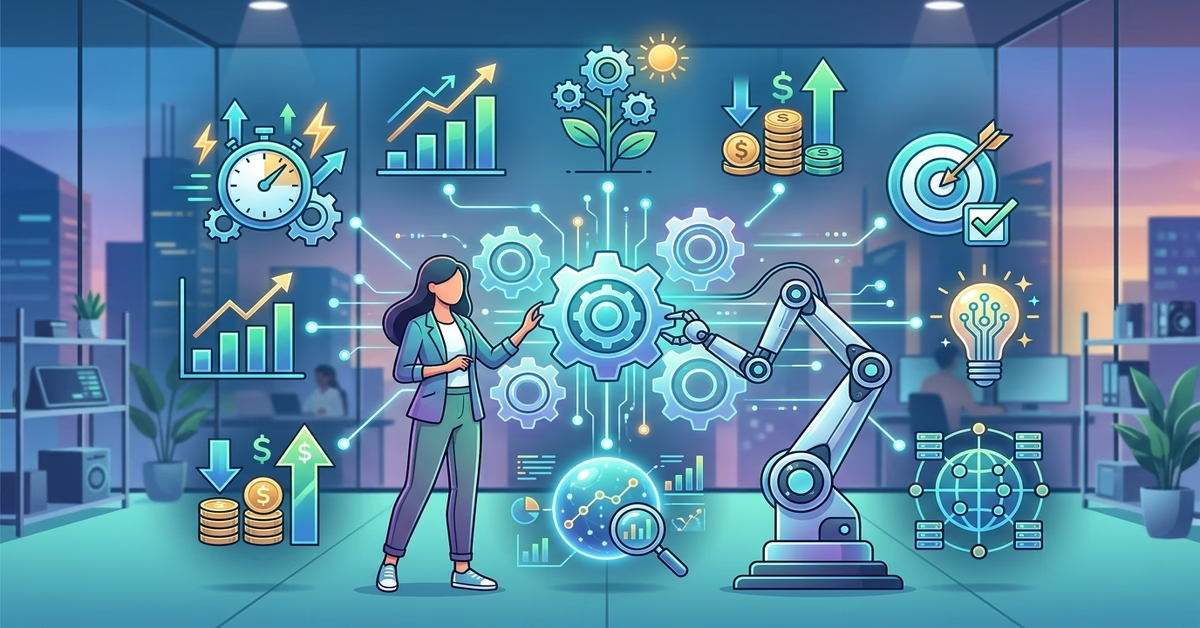
Top 7 AI Automation Benefits for Growing Businesses
You hear a constant stream of noise about artificial intelligence taking over the corporate space. Most of it is fluff. But when you look past the hype and the panic, the actual ai automation benefits are entirely practical. They solve the exact problems keeping you up at night—communication bottlenecks, shrinking profit margins, and talented teams burning out from mindless, repetitive tasks.
This is not a theoretical breakdown of futuristic technology. This is an honest look at what happens when you hand your heavy, manual workloads over to software. If you want a solid foundation on the mechanics before looking at the specific perks, reading The Complete Guide to AI Automation makes a lot of sense.
Right now, we are going to break down the specific, tangible ways this technology physically changes how your company operates. We will start from the ground level of daily tasks and work our way up to high-level growth strategies.
1. Massive Data Processing — Turning Noise Into Useful Numbers
Humans are terrible at reading spreadsheets with fifty thousand rows. Machines are fantastic at it. Data processing is often the most tedious, mind-numbing part of running any business. You have sales figures, customer feedback surveys, inventory counts, and marketing metrics. Sifting through that mountain of information takes hours, and usually leaves you with a headache.
Artificial intelligence tools instantly pull trends, flag anomalies, and organize the chaos. Instead of paying a data analyst to spend three days building a report on last quarter’s buying trends, an automated system updates that dashboard in real-time. You instantly see which products are moving, which marketing campaigns are failing, and where your buyers are dropping off.
The tradeoff here is simple: you have to feed the system clean information. Garbage in gives you garbage out. If your databases are an unorganized mess, the AI cannot magically fix your bad habits. But once you set clear rules for how information enters your system, you stop paying smart people to act like human calculators.
Stop using your team’s brainpower for basic sorting and start using it for actual strategy.
If organizing data sounds great, fixing the mistakes inside that data is the natural next step.
2. Drastic Error Reduction — Because Typos Cost Real Money
Let’s be brutally honest. Even your best, most reliable employees make mistakes. A missed zero on an outgoing invoice, a transposed number on a shipping address, or a double-booked client meeting. Error reduction is one of the quietest but most valuable perks of bringing algorithms into your daily routine. Software does not get tired at 4 PM on a Friday. It does not get distracted by an office conversation.
When you automate your invoicing, your lead routing, and your contract generation, you remove the human element from the data entry process. The system copies the exact information the client provided and moves it exactly where it belongs. This drops your error rate to near zero.
Fair warning: you still need human oversight for high-stakes decisions. If a system gets confused by an unusual input, it might confidently do the wrong thing. Setting up review stages for large transactions is just good business. If you are just figuring out where to apply this concept first, a Beginner Tutorial on AI Automation for Small Business will show you how to automate your basic forms and stop those simple, expensive mistakes.
Perfect accuracy might be impossible, but automation gets you significantly closer than a fatigued human ever will.
Fixing mistakes saves money, but speeding up the actual work changes the whole dynamic.
3. Supercharged Productivity — Doing More Without the Burnout
Productivity used to mean asking your team to work faster and skip their lunch breaks. Now it means removing the work they should not be doing in the first place. This is where you see massive shifts in daily efficiency.
Think about the average workday. How much time do you spend sorting emails, updating task statuses, scheduling meetings, and moving files from one folder to another? AI steps in to handle these micro-tasks invisibly in the background. When an email arrives from a top-tier client, the system can read the intent, categorize it, draft a suggested response, and alert you on your phone.
This is not about replacing your employees. It is about giving them their time back. When a graphic designer stops spending two hours a day answering administrative emails, they spend two more hours actually designing. When a salesperson stops manually logging call notes into the CRM, they have time to make twenty more calls.
You hire humans for their creativity, empathy, and problem-solving skills, so let the machines handle the mindless clicking.
Reclaiming all of that wasted time naturally exposes how your different tasks link together.
4. Workflow Optimization — Untangling the Internal Mess
Every growing company eventually hits a wall. The manual processes that worked perfectly when you were making $100,000 a year will completely break when you cross $1,000,000. Workflow optimization is how you fix the internal plumbing of your business.
Instead of treating your sales team, your marketing department, and your fulfillment center like isolated islands, you connect them. When a new prospect fills out a form on your website, an automated workflow instantly adds them to your email sequence, pings your sales team on Slack, and creates a fresh profile in your database. Nobody has to manually notify anyone else. The internal gears just turn.
The catch? You have to map out your process properly before you automate it. If you automate a bad, confusing process, the software just makes the bad process happen faster. You need to clearly define who does what and when. Once you do, the communication bottlenecks that cause missed deadlines simply disappear.
Connect your tools properly once, and watch your entire operation run like a well-oiled machine.
Once the internal team is operating smoothly, you can turn that same speed toward your buyers.
5. Instant Customer Satisfaction — Support That Actually Helps
Nobody likes waiting on hold for forty-five minutes just to get a simple shipping update. Modern AI chatbots and automated support desks have evolved far past those rigid, frustrating phone menus we all hate. Customer satisfaction skyrockets when people get accurate answers immediately.
Today’s automated agents understand natural language. They can reference a specific buyer’s account history, process a refund, update an address, or troubleshoot a common tech issue without ever waking up a human employee. Because these systems run twenty-four hours a day, a buyer in a different time zone gets the exact same level of service at 3 AM as someone calling at noon.
In fact, building and setting up these specific support systems for other brands is so highly demanded that learning How to Start a Profitable AI Automation Agency has become an incredibly lucrative industry. Businesses are desperate to outsource this setup because the results are immediate.
Your clients get instant answers, and your human support agents only have to deal with highly complex, nuanced problems.
Happy customers naturally stick around longer, bringing us directly to the financial benefits.
6. Serious Cost Reduction — Keeping More of What You Make
Every business owner wants to lower their overhead. True cost reduction happens because you stop paying for unnecessary software bloat, stop paying overtime for manual data entry, and stop hiring temporary workers for seasonal spikes.
When software handles your administrative heavy lifting, your payroll expenses stabilize. You are no longer throwing human bodies at logistical problems. However, setting up these systems is not free. You have to spend money to buy the software subscriptions, build the API connections, and potentially hire an expert to configure the logic.
This requires a long-term mindset. The return on investment is massive, but it is not always instantaneous. If you are worried about the upfront price tag, reading up on Understanding AI Automation Cost and ROI Expectations will clarify exactly when you can expect to see your money come back into your pocket.
The initial investment might sting a little, but the continuous monthly savings will quickly pay for the entire setup.
Once your financials are secure and predictable, you are finally ready to push the gas pedal on expansion.
7. True Operational Scalability — Growing Without Breaking
Adding one hundred new customers to your roster usually means a period of intense panic. You have to hire new account managers, buy new equipment, and rent more office space. Operational scalability means adding one hundred new customers and changing absolutely nothing about your infrastructure.
This is the ultimate competitive advantage for growing businesses. As your competitors try to grow, their administrative costs swell. They get bloated, slow, and expensive. Their profit margins shrink because it takes more money to manage the larger workload.
When you rely on high operational efficiency through automated systems, your business stays lean. Software handles ten thousand daily transactions just as easily as it handles ten. You take on massive new workloads, serve more clients, and increase your revenue while your overhead costs barely move. You outmaneuver the competition simply because you do not carry the same heavy, expensive baggage they do.
Business growth should feel exciting and profitable, not like a constant crisis you have to manage.
Wrapping Up Your Automation Strategy
Technology is not magic; it is simply a tool. The real ai automation benefits come to those who apply these tools to solve actual, measurable problems. You do not need to replace your entire staff with robots by next Tuesday. That is a recipe for disaster.
Start small. Look for the most annoying, repetitive task in your daily routine and automate that one specific thing. Experience the efficiency first-hand. Watch the error rate drop. See how it affects your return on investment. Once you trust the system with the small tasks, you can confidently scale it across your entire company.
Take the time to build strong foundations now, and you will secure the business growth you actually want without losing your sanity in the process.